Introduction
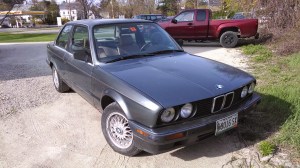
This BMW 325i was purchased in 2013 as a project car. While it spent more time on jack stands than it did on the road, I learnt a huge amount about not only working on a car, but on a rusty car. Every single bolt put up a fight on this car.
Maintenance & Upgrades
Upon receiving the car, I started detailing and prioritizing a list of maintenance this car needed.
Timing Belt
The M20 engine in this car is an interference engine, meaning at a certain point in the engine’s rotation, the valves take up the same space as the pistons. During normal operation the timing belt that drives the cam shaft keeps the valves from interfering. If the timing belt fails, however, this is a catastrophic failure causing the values to smash into the pistons and bend. Without knowing the history of the timing belt, it was up first for replacement.
What I soon realized was common trend, there are plenty of other parts to replace “while-you’re-in-there”. Parts replaced during this job:
- Timing Belt, Tensioner Spring, Tensioner Roller
- Thermostat
- Water Pump
- Coolant/Antifreeze – 1.5 Liters
- Thermostat, Thermostat O-Ring
- Front Camshaft Seal
- Thermostat to Water Pump
- All Coolant Hose (7 in total)
5-Speed Transmission Swap
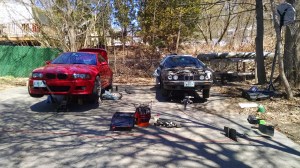
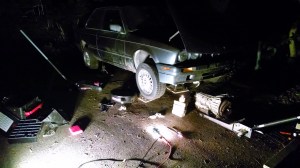
As a manual transmission is more engaging to drive, the 4-speed automatic was swapped out for a 5-speed manual. This was one of the more involved projects I had ever taken on at the time. The parts list was over 80 lines long. Not to mention this was done in the driveway on jack stands.
“While you’re in there” parts included:
- Flex coupling and center support bearing on the driveshaft
- Rubber mounts on the transmission brace
- Pilot bearing and rear main seal on the engine
Lessons learned: using a torch to heat exhaust bolts, combining extensions, swivels and flex sockets to get to seemingly impossible exhaust header and transmission housing bolts, don’t get automatic transmission on your shirt – its a skin irritant.
Diagnosis: ABS & Brake Light
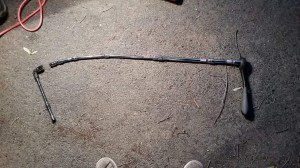
At one point I started diagnosing why the ABS system was not functioning. First, I found the fuse was blown for that circuit. But, upon replacing it I found that tapping the brakes blew this fuse again. I also found a mysterious extra wire running down the interior of the car…
At some point in the cars history, an owner took the easy way out an ran a wire straight from the brake light switch on the pedal directly to the rear brake light circuit. After replacing the ABS control unit, and using the original brake light wiring, everything starting working again. Lesson learned: diagnosing automotive electrical systems
Diagnosis: Failure to Start
One day the car refused to start, and wouldn’t crank at all. First check, battery was fine. As I starting checking various sub-systems, I eventually found that the fuel sender unit (under the rear seat) was not running, even though the plug going to it showed full voltage.
However, when supplied by a separate 12V power supply, the fuel pump ran fine. So there was a voltage drop somewhere along the way. Referring back to the electrical diagrams, I found that there was a inline fuse coming from the battery in the trunk. I discovered that corrosion through the rear wheel well had also corroding this fuse, causing a high resistance.
The plug at the fuel pump showed full voltage, but only when no current was being drawn. When the fuel pump drew any current, all the voltage was dropped over the corroded fuse. Lesson learned: diagnosing automotive electrical systems
Diagnosis: Grinding Sound
The car had always had a grinding sound coming from the rear, but was difficult to pin point. As an amateur, shadetree mechanic, I started with a commonly replaced part on cars with this high-milage – the rear wheel bearings. This did nothing to change the sound. After a drive, I jacked the car up and felt around for heat. The front of the differential was much warmer than the rest of the casting.
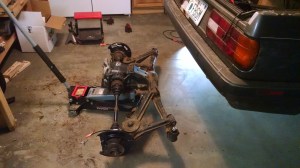
Thinking I had it figured out, I found a updated differential with a higher reduction ratio and limited slip differential. However, this still didn’t change the sound. Eventually I noticed the driveshaft had a scrape mark around its circumference. It had been scraping on a cross member. As it turned out, the rubber rear subframe mounts were completely rotted out, allowing the whole subframe & differential assembly to ride closer to the rest of the car, causing the scraping. Finally, changing these rubber mounts fixed the scraping sound. Lesson learned: sometimes its okay to pay a professional to diagnose an issue.
Misc. Maintenance and Fixes
The following projects were also taken on:
- Front Control Arms
- Front Tie Rods

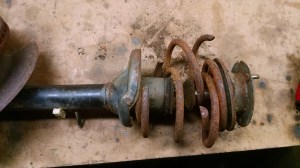
- Broken springs replaced
- Replaced broken gears in odometer
 Ethan's Projects